Biography
The son of an engraver, in 1936 he enlisted in the Republican army and fought on the Lleida front. During these years, he began his first writings, already marked by left-wing militancy and Catalanism. After the war, he performed military service in the Francoist army and, upon returning to Barcelona, worked as an engraver and bookseller. Reading Freud and an interest in psychic automatism led him to write hypnagogic images. His relationship with J.V. Foix, who guided him toward the sonnet, was decisive. In 1941, he wrote La bola i l’escarabat. He lived through years of great hardship and, in 1948, co-founded the group Dau al Set, which was also linked to the magazine Algol. Much of his work remained unpublished for a long time.
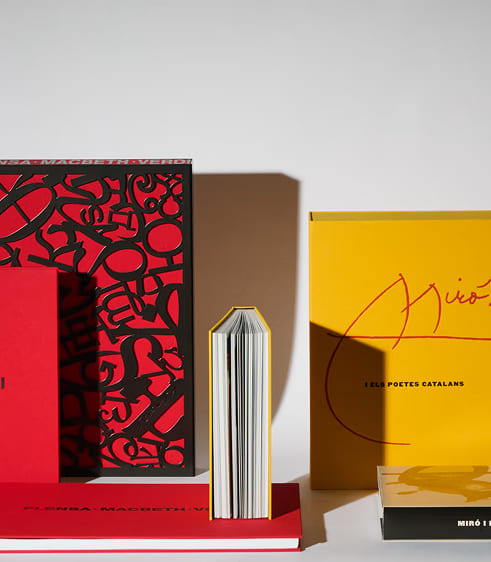
Conceiving art as a space without boundaries between genres, he collaborated with numerous artists. His relationships with Joan Miró—an ethical and aesthetic reference point—and Antoni Tàpies were particularly noteworthy. He also worked with musicians, sculptors, and poets, and showed a constant interest in cinema, collaborating with Pere Portabella and other creators, as well as on audiovisual and television projects.
His poetic work constitutes an investigation into language and communication codes, based on irony, decontextualization, free association, and the rejection of the separation between word and object, with a strong presence of visual poetry and object poems. This groundbreaking poetics coexists with a rigorous mastery of traditional forms such as the ode, the sonnet, and the sestina. His production is extensive and scattered, with fundamental collections such as Poesia rasa, Poemes de seny i cabell, and Ball de sang. The evolution of his work shows a shift from initial enthusiasm toward a certain disenchantment.
He understood theater as scenic poetry, with short pieces that were often grotesque and close to the theater of the absurd. From the 1970s onwards, he gained institutional recognition, receiving numerous awards and distinctions. The Espai Escènic Joan Brossa and the Joan Brossa Foundation were established, dedicated to the dissemination of his work, which achieved significant public and international visibility.